
Pay-As-You-Go Workers’ Compensation for Hawaii Employers
Summary
Pay-as-you-go workers’ compensation in Hawaii is a billing method, not a new program. It ties premium payments to actual payroll as you go, instead of leaning on one large estimate at the start of the year. It doesn’t change an employer’s coverage responsibilities under Hawaii’s system. Hawaii’s workers’ compensation program still provides benefits for employees with work-related injuries or illnesses, overseen by the Department of Labor and Industrial Relations and its Disability Compensation Division.[1][6]
What pay-as-you-go workers’ compensation means
Pay-as-you-go workers’ compensation is a premium billing method, full stop. Instead of paying one large estimated premium at the start of a policy period and reconciling later, the employer’s payroll data gets used during each payroll cycle to calculate and remit premium more often. The policy still sits inside the ordinary workers’ compensation insurance framework. The carrier or program still sets policy terms, classifications, audit requirements, and claim administration.
- Estimated annual premium
- The starting premium, based on expected payroll, job classifications, and policy terms.
- Pay-as-you-go billing
- A payment method that uses current payroll information to spread premium payments across payroll cycles.
- Premium audit
- The reconciliation process that compares actual payroll and classification data against what was used for billing.
What it changes and what it does not change
For Hawaii employers, the practical value of pay-as-you-go workers’ compensation is usually administrative. It narrows the gap between estimated payroll and actual payroll, which matters most for employers with seasonal hiring, changing headcount, or variable hours. It doesn’t change the legal nature of workers’ compensation coverage or the benefits available to injured employees.
- It can support cash flow by spreading premium payments across payroll cycles instead of loading more cost at the start of the policy period.
- It can cut down on end-of-period surprises when payroll changes get captured accurately throughout the year.
- It doesn’t remove the employer’s responsibility to secure workers’ compensation coverage for covered employees.
- It doesn’t change claim rights, medical benefits, wage replacement benefits, or dispute processes under Hawaii’s system.[6]
- It doesn’t make employees responsible for paying the cost of workers’ compensation coverage.
Hawaii coverage and compliance basics
Hawaii’s workers’ compensation system provides benefits for employees who suffer job-related injuries or illnesses, including medical care and wage replacement benefits when applicable.[6] The Department of Labor and Industrial Relations (DLIR) is the state agency connected to labor programs, and its Disability Compensation Division (DCD) administers workers’ compensation matters.[1][6] A billing method doesn’t change those public responsibilities or the state’s role in overseeing the system.
Workers’ compensation also sits alongside other employment obligations. Payroll records, employee status, work locations, and job duties all shape how a policy gets administered. This overview is general information for employers, not legal advice.
For a related services overview, see HR services.
Why payroll data matters
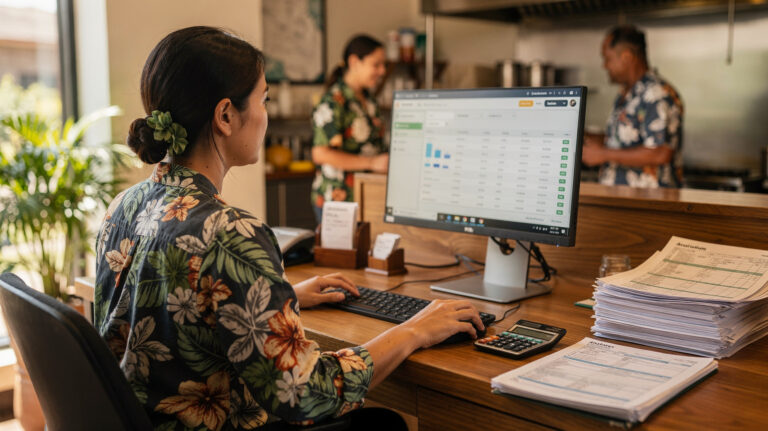
A pay-as-you-go arrangement is only as good as the payroll information feeding it. If payroll data arrives late, incomplete, or inconsistent, the billing method loses much of its value. Accurate payroll operations help the employer, carrier, broker, or HR partner keep cleaner records during the policy period.
- Current employee rosters keep covered workers tied to the correct policy and payroll records.
- Accurate wage data keeps premium calculations tied to actual payroll instead of outdated estimates.
- Clear job duty information supports proper classification review by the carrier or program.
- Timely updates for new hires, terminations, and role changes cut down on reconciliation issues.
- Consistent payroll cycles make it easier to line up premium billing with the employer’s normal operating rhythm.
Payroll often sits beside this topic, so see Hawaii payroll services.
Safety, claims, and return-to-work support still matter
Pay-as-you-go billing can make premium payments feel more current, but it doesn’t touch the underlying risk of workplace injury. Employers still need safety practices, supervisor training, early claim communication, and return-to-work planning where it fits. Those activities shape employee experience and operational continuity, even when the premium billing method gets modernized.
A pay-as-you-go setup works best paired with active safety, claims handling, and return-to-work coordination, not treated as a payroll feature alone.
Claims handling also takes coordination among the employer, employee, insurer, and state process. The federal workers’ compensation contact list identifies state workers’ compensation officials by state, a reminder that workers’ compensation administration stays state specific.[2]
For more on this topic, see Workers compensation.
For more on this topic, see Infographic True Costs Workers Compensation.
How this fits with HR and PEO operating models
Hawaii employers can get workers’ compensation through brokered insurance markets, and some programs may use a captive or other group insurance structure at a high level. The right structure depends on coverage availability, underwriting, payroll operations, risk profile, and the employer’s broader HR operating model. No billing model alone guarantees lower costs, so be wary of claims that lean on unsupported savings percentages.
Workers’ compensation also sits beside payroll, taxes, onboarding, benefits administration, and workplace compliance. In a Professional Employer Organization (PEO) or broader HR outsourcing arrangement, the employer may get help coordinating these functions through a connected platform and a human support team. That’s especially useful when payroll data, insurance administration, claims communication, and employee service all need to stay aligned.
ProService is one example of a Hawaii-based partner that places workers’ compensation inside a broader people, benefits, and local expertise model. At a high level, that means payroll, taxes, onboarding, and administration get handled accurately on cycle while workers’ compensation is supported alongside safety, claims, and return-to-work coordination. The idea is Expert Care and Exceptional Coverage: taking care of the business and its people, not just the paperwork.
FAQ
Is pay-as-you-go workers’ compensation a separate Hawaii program?
Is pay-as-you-go workers’ compensation a separate Hawaii program?
No. Pay-as-you-go workers’ compensation is a billing approach, not a separate statutory program or special state option. Hawaii’s workers’ compensation framework, and the roles of DLIR and DCD, still apply no matter how premium payments are scheduled.[1][6]
Does pay-as-you-go billing change who needs workers’ compensation coverage?
Does pay-as-you-go billing change who needs workers’ compensation coverage?
No. A billing arrangement doesn’t change an employer’s underlying coverage responsibility. Hawaii’s workers’ compensation system applies to covered employment relationships, so employers should judge coverage obligations by Hawaii requirements, not by premium payment timing.[6]
Can pay-as-you-go workers’ compensation help with cash flow?
Can pay-as-you-go workers’ compensation help with cash flow?
It can help some employers, since premium payments spread across payroll cycles and track current payroll more closely. It shouldn’t be treated as a promise of lower total cost: classification, payroll, claims, policy terms, and audit results still matter.
Does pay-as-you-go billing change benefits for injured employees?
Does pay-as-you-go billing change benefits for injured employees?
No. An injured employee’s benefits are tied to Hawaii’s workers’ compensation system, not to the employer’s premium billing method. The state describes workers’ compensation as providing benefits for work-related injuries and illnesses, including medical care and wage replacement benefits when applicable.[6]
What information matters most for pay-as-you-go workers’ compensation?
What information matters most for pay-as-you-go workers’ compensation?
Accurate payroll information matters most, since payroll activity drives the periodic premium calculations. Employers should also keep employee rosters, job duty information, wage data, and employment changes current so billing and later reconciliation stay clean.
Can a Hawaii employer use pay-as-you-go billing with an HR or PEO partner?
Can a Hawaii employer use pay-as-you-go billing with an HR or PEO partner?
Yes, depending on the partner, insurance arrangement, and program terms. In an HR outsourcing or Professional Employer Organization model, workers’ compensation can be coordinated with payroll, onboarding, taxes, safety support, claims communication, and broader employee administration.
Does pay-as-you-go workers’ compensation replace safety or claims management?
Does pay-as-you-go workers’ compensation replace safety or claims management?
No. It changes how premium payments are timed, but it doesn’t reduce the need for safety practices, claim communication, or return-to-work planning. Those activities stay important because workers’ compensation involves people, workplace operations, insurance administration, and state oversight.